Pañcāṅga — the reckoning of time
पञ्चाङ्ग
Also written: panchanga · panchang · hindu calendar · tithi nakshatra yoga karana · muhurta · पञ्चाङ्ग
Pañcāṅga means 'five limbs'. An Indian calendar does not record only the date; it records five independent cycles running at once, and their combination is what makes a moment auspicious or otherwise.
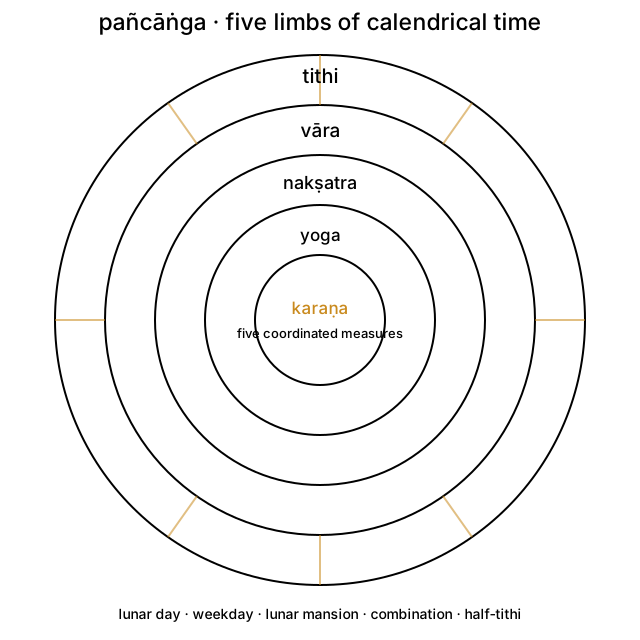
| Limb | Measures | Count |
|---|---|---|
| Tithi | The lunar day — each 12° of the moon's separation from the sun | 30 per lunar month, in two pakṣas of 15 |
| Vāra | The weekday and its ruling planet | 7 |
| Nakṣatra | The lunar mansion the moon occupies | 27 (28 with Abhijit) |
| Yoga | The combined longitude of sun and moon | 27 |
| Karaṇa | Half a tithi | 11 kinds — 4 fixed, 7 recurring |
The year as a wheel — and the count on it
The riddle-hymn of the Ṛgveda, Dīrghatamas's Asya Vāmasya, states the calendar as a puzzle about a wheel, and the numbers in the puzzle are the year's own.
द्वादश प्रधयश्चक्रमेकं त्रीणि नभ्यानि क उ तच्चिकेत। तस्मिन्साकं त्रिशता न शङ्कवोऽर्पिताः षष्टिर्न चलाचलासः॥
dvādaśa pradhayaś cakram ekaṁ trīṇi nabhyāni ka u tac ciketa tasmin sākaṁ triśatā na śaṅkavo'rpitāḥ ṣaṣṭir na calācalāsaḥ
Twelve are the fellies, one the wheel, three the naves — who has understood it? In it are set together three hundred and sixty pegs, as it were, which do not loosen.
Twelve months, one year, three seasons in the older division, three hundred and sixty days. The hymn is not being obscure for its own sake; it is stating a calendar in the form of a riddle so that the numbers are remembered. Earlier in the same hymn the count is given differently, and the difference is the whole of the pañcāṅga's method.
द्वादशारं नहि तज्जराय वर्वर्ति चक्रं परि द्यामृतस्य। आ पुत्रा अग्ने मिथुनासो अत्र सप्त शतानि विंशतिश्च तस्थुः॥
dvādaśāraṁ nahi taj jarāya varvarti cakraṁ pari dyām ṛtasya ā putrā agne mithunāso atra sapta śatāni viṁśatiś ca tasthuḥ
The twelve-spoked wheel of ṛta revolves around the heaven and never wears out. On it, O Agni, stand seven hundred and twenty sons in pairs.
The Vedāṅga Jyotiṣa, the oldest surviving astronomical manual in the tradition, states plainly why the whole apparatus was developed — and it is not fortune-telling.
yathā śikhā mayūrāṇāṁ nāgānāṁ maṇayo yathā tadvad vedāṅga-śāstrāṇāṁ jyotiṣaṁ mūrdhani sthitam
As are the crests on peacocks and the jewels on serpents, so does jyotiṣa stand at the head of the sciences that are the limbs of the Veda.
The claim of primacy is functional. The Vedic rites are tied to moments — new moon, full moon, solstice, the beginning of a season — and a rite performed at the wrong moment is not a rite. Astronomy was therefore the discipline the entire ritual calendar depended on, which is why it was developed with such care and why the pañcāṅga is an astronomical document before it is a religious one.
The year
The calendar is lunisolar: months are lunar, the year is solar, and an intercalary month (adhika māsa) is inserted roughly every 32½ months to keep them aligned. The year divides into two ayanas — uttarāyaṇa, the sun's northward course, and dakṣiṇāyana, the southward — and into six ṛtus of two months each: vasanta, grīṣma, varṣā, śarad, hemanta and śiśira.
Of the five limbs, one is singled out in the Gītā's chapter of supreme instances — and it is the moon, the fastest-moving and therefore the most finely dividing of the markers.
आदित्यानामहं विष्णुर्ज्योतिषां रविरंशुमान्। मरीचिर्मरुतामस्मि नक्षत्राणामहं शशी॥
ādityānām ahaṁ viṣṇur jyotiṣāṁ ravir aṁśumān marīcir marutām asmi nakṣatrāṇām ahaṁ śaśī
Among the Ādityas I am Viṣṇu; among lights, the radiant sun. Among the Maruts I am Marīci; among the nakṣatras I am the moon.
The pairing is exact for a lunisolar calendar: the sun among the luminaries, the moon among the nakṣatras. The year is the sun's; the day-by-day reckoning is the moon's. Two of the five limbs — tithi and nakṣatra — measure the moon, a third measures the two together, and only the vāra is independent of both. The pañcāṅga is, structurally, a device for stating where the moon stands relative to the sun.
Muhūrta
A muhūrta is a division of about 48 minutes — thirty in a day and night. Choosing one is the practical purpose of the whole apparatus: the five limbs are weighed together, inauspicious periods are avoided, and certain windows are held always favourable, among them Abhijit, the eighth muhūrta, at midday.
The tattvas — how existence is layered
Sāṅkhya's twenty-five and Kashmir Śaivism's thirty-six: the levels between pure consciousness and solid earth,…
Time — the yugas, kalpas and cycles
Cyclical time on an enormous scale: the four yugas and their lengths, the manvantaras, a day of Brahmā, and wh…
Karma and rebirth
The three kinds of karma, what free will means inside it, the subtle body that carries it, and why the doctrin…
The lokas — the planes of existence
The fourteen worlds, the three-world formula of daily invocation, and how the lokas are read as states rather …
Last revised 2026-08-16. Corrections are welcome — see how this site is written.