The six Vedāṅgas — the limbs of the Veda
षड्वेदाङ्ग
Also written: vedanga · six vedangas · limbs of veda · shiksha kalpa vyakarana nirukta chandas jyotisha
A Veda that cannot be pronounced correctly, performed correctly, parsed, etymologised, scanned or timed is unusable. The six Vedāṅgas are the sciences that make it usable — and each of them grew into a full discipline in its own right.
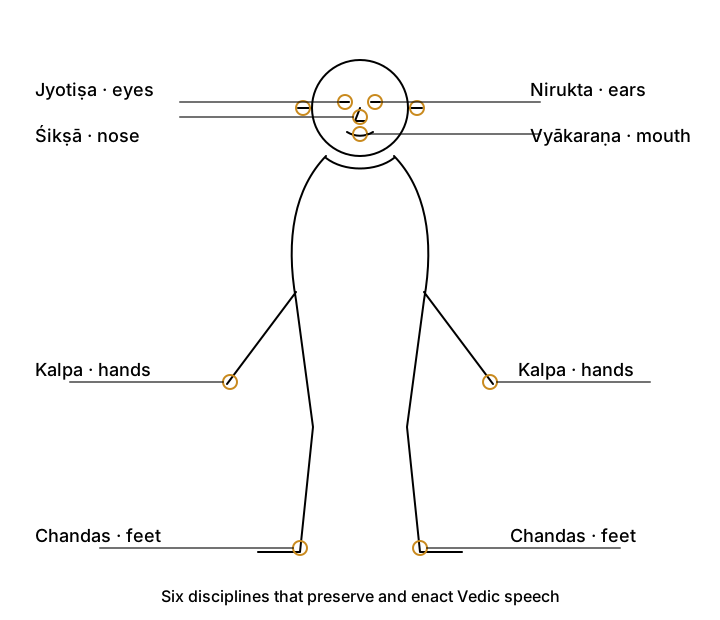
The body-image is not a modern teaching device. It is stated in the Pāṇinīya Śikṣā, in two verses that assign each limb its organ and then draw the conclusion.
छन्दः पादौ तु वेदस्य हस्तौ कल्पोऽथ पठ्यते। ज्योतिषामयनं चक्षुर्निरुक्तं श्रोत्रमुच्यते॥
chandaḥ pādau tu vedasya hastau kalpo'tha paṭhyate jyotiṣām ayanaṁ cakṣur niruktaṁ śrotram ucyate
Metre is the feet of the Veda; ritual procedure is recited as its hands; the course of the lights is its eye; etymology is called its ear.
शिक्षा घ्राणं तु वेदस्य मुखं व्याकरणं स्मृतम्। तस्मात्साङ्गमधीत्यैव ब्रह्मलोके महीयते॥
śikṣā ghrāṇaṁ tu vedasya mukhaṁ vyākaraṇaṁ smṛtam tasmāt sāṅgam adhītyaiva brahma-loke mahīyate
Phonetics is the nose of the Veda, and grammar is remembered as its mouth. Therefore, having studied it together with its limbs, one is honoured in the world of Brahman.
Tasmāt sāṅgam adhītya — 'therefore, having studied it with its limbs' — is a rule about competence, and it explains the assignments. Grammar is the mouth because it is the organ that produces; phonetics is the nose because breath is shaped there; the eye is astronomy because seeing is what tells you when. The verse is claiming that a Veda studied without its limbs is a torso, and it means that literally: no such student is held to have studied the Veda at all.
And yet the Muṇḍaka, listing exactly these six alongside the four Vedas, places all ten in the aparā vidyā — the lower knowledge. Both statements are held at once, and the combination is the tradition's actual position on scholarship: indispensable, and not the goal. One may not skip the limbs; one may not mistake them for the body.
| Vedāṅga | Called | Science | Function |
|---|---|---|---|
| Śikṣā | The nose | Phonetics and phonology | Exact pronunciation, accent, quantity and articulation of every syllable |
| Kalpa | The hands | Ritual procedure | How every rite is performed — Śrauta, Gṛhya, Dharma and Śulba Sūtras |
| Vyākaraṇa | The mouth | Grammar | The structure of the language — culminating in Pāṇini's Aṣṭādhyāyī |
| Nirukta | The ears | Etymology and semantics | What the words mean, especially the difficult ones — Yāska's Nirukta |
| Chandas | The feet | Metre | The metres in which the mantras stand: gāyatrī, triṣṭubh, jagatī and the rest |
| Jyotiṣa | The eyes | Astronomy and time-reckoning | When a rite must be performed — the calendar, the seasons, the sky |
Śikṣā
The science of sound: place of articulation, effort, pitch, duration. Preserved Vedic accent for millennia.
Kalpa
Ritual procedure — and inside it the Śulba Sūtras, the oldest geometry in the world.
Vyākaraṇa
Pāṇini's 3,959 rules: the first complete generative grammar of any language.
Nirukta
Yāska's etymology — the oldest surviving work of semantics.
Chandas
Metre, and with Piṅgala the binary notation and the sequence later called Fibonacci.
Jyotiṣa
The eye of the Veda — time, calendar, and the position of the sky at every moment.
In this section
Śikṣā — the science of sound
Vedic phonetics: articulation, accent, duration and the discipline that preserved the Veda's sound unchanged for thousands of years.
Kalpa — ritual procedure, and the world's oldest geometry
The Śrauta, Gṛhya, Dharma and Śulba Sūtras: how every public rite, household rite and legal duty is performed — and the altar geometry that produced the Pythagorean theorem in India.
Vyākaraṇa — grammar, and Pāṇini
The Aṣṭādhyāyī: 3,959 rules that generate the whole of Sanskrit, the first formal generative system in human history, and why computer science rediscovered it.
Nirukta — etymology and meaning
Yāska's Nirukta, the oldest surviving work on word-meaning, its method, and the debate on whether Vedic words have fixed or derived sense.
Chandas — metre, and the first binary notation
The Vedic metres, Piṅgala's Chandaḥśāstra, and the mathematics it produced: binary numbers, the sequence later called Fibonacci, and Pascal's triangle.
Jyotiṣa — the eye of the Veda
The science of light and time: its three skandhas, the nakṣatra system, the pañcāṅga, and why a rite's moment matters as much as its procedure.
The sources of knowledge in Sanātana Dharma
The complete library: Nigama and Āgama, śruti and smṛti, the four Vedas with their four layers, the six Vedāṅg…
Śruti — that which was heard
What apauruṣeya means, how the Veda was preserved syllable-perfect for millennia without writing, and why śrut…
Smṛti — that which was remembered
The vast human-authored body: Vedāṅga, Itihāsa, Purāṇa, Dharma Śāstra, Sūtra, Darśana, Āgama and Kāvya — deriv…
Nigama and Āgama — the two revealed streams
The Vedic and the Tantric revelations: their different forms, their different eligibility rules, why every tem…
The four Vedas
Ṛgveda, Yajurveda, Sāmaveda and Atharvaveda — what each contains, the priest each belongs to, its śākhās, and …
Ṛgveda
The oldest surviving text of the tradition: 1,028 hymns in ten maṇḍalas, its structure, its great hymns, and w…
Last revised 2026-08-16. Corrections are welcome — see how this site is written.